A reading habit does not require long sessions, perfect streaks, or finishing every saved article. It grows from small, repeatable moments: opening something worthwhile, reading until a natural stopping point, and returning again tomorrow. This guide explains how to build a reading habit without pressure—and how a calmer system for saved articles can help.
How to build a reading habit at a glance
| Question | Practical answer |
|---|---|
| How much time do I need? | Five to fifteen minutes can be enough for a meaningful session. |
| What should I read first? | Start with something short or an article you already began. |
| How often should I read? | Most days is a useful target, but missing a day is not failure. |
| What if my list is overwhelming? | Read one item, archive what no longer matters, and save less going forward. |
| How do I stay consistent? | Pair reading with an existing routine and make the next article easy to find. |
Why do most reading habits fail?
Most reading habits fail for predictable reasons—not because someone lacks discipline.
Common causes include:
- Saving more than you can read. A growing backlog signals opportunity, but it can also make every article feel equally urgent or equally ignorable.
- Choosing the wrong article for the time available. Opening a forty-minute essay when you have eight minutes often ends in frustration, not progress.
- Restarting instead of continuing. Returning to the beginning of a half-read article wastes the mental work you already invested.
- Treating reading like a performance. Streaks, word counts, and social comparison can help some people, but they can also turn reading into another obligation.
- Reading in a distracting environment. Notifications, tab switching, and cluttered interfaces make sustained attention harder than the content itself.
A sustainable habit addresses these friction points rather than demanding more willpower.
What is a pressure-free reading habit?
A pressure-free reading habit has three qualities:
- It fits real life. Sessions match the time you actually have.
- It rewards return visits. You pick up where you left off instead of starting over.
- It tolerates imperfection. Missing a day, abandoning a dull article, or reading slowly are all acceptable.
The measure of success is not how many articles you save. It is how often you return to reading and how often you finish something that mattered to you.
How do you start a reading habit in small steps?
Step 1: Anchor reading to something you already do
Attach reading to an existing routine rather than inventing a new block of time from nothing. James Clear calls this habit stacking: pair the new behavior with a current habit you already do. Checked October 18, 2026. Examples:
- One article with morning coffee.
- A short piece during a commute or walk. You can read it on the screen, and PagePanda text-to-speech is available when reading on a screen is not practical.
- Ten minutes before bed, with notifications silenced.
The anchor matters more than the clock. A repeatable cue makes the habit easier to remember.
Step 2: Choose one article, not the whole backlog
Decision fatigue is a hidden enemy of reading habits. When faced with hundreds of saved links, many people read nothing.
Instead:
- Open one article that fits today’s time.
- Prefer something you already started over something brand new.
- If you only have a few minutes, choose a shorter piece.
PagePanda’s reading-focused Home is designed around this problem. Continue Reading surfaces articles with saved progress. Quick Reads highlights shorter pieces that may fit a small window. You do not need to scroll through an undifferentiated list to find a reasonable next choice.
Step 3: Read until a natural stopping point, then stop
A natural stopping point might be:
- The end of a section.
- The end of a short article.
- A point where you understand the author’s main argument.
Stopping cleanly—rather than pushing through exhaustion—makes it easier to return. Saved reading progress means you can resume without rereading everything.
Step 4: Save less, read more
If your backlog grows faster than you read, the habit will feel impossible no matter which app you use.
Try a simple rule: for every new article you save, finish or archive one existing item. This keeps the library approachable without requiring a dramatic purge.
Step 5: Let progress be visible, not punitive
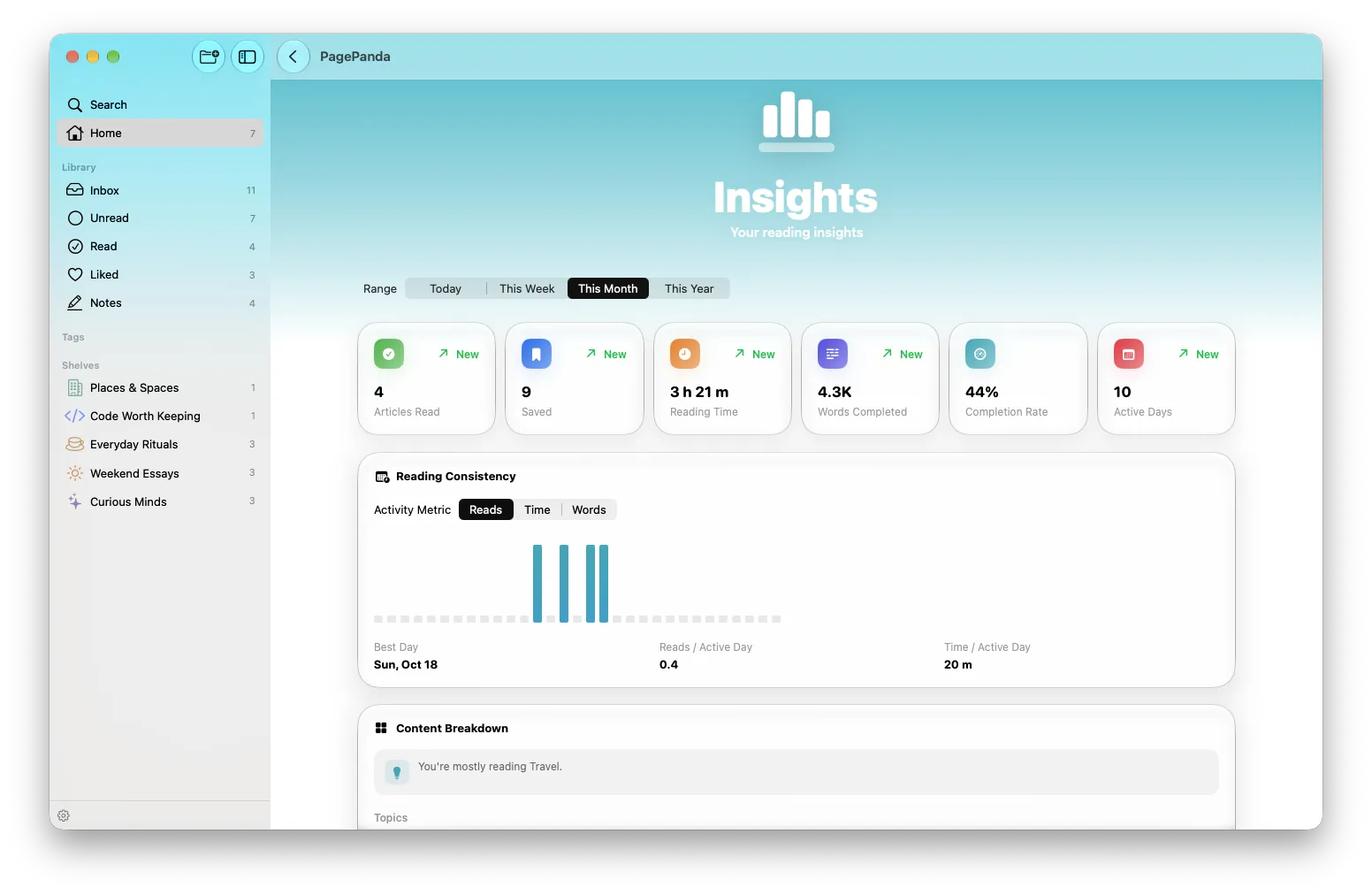
Tracking can help when it feels encouraging. PagePanda includes reading streaks, personal Insights, and Achievements that celebrate milestones such as finishing your first article or reading on consecutive days.
Use these tools as feedback, not judgment. A broken streak is not a moral failure—it is a normal week. What matters is whether you return to reading.
How much should you read each day?
There is no universal daily quota. Research on habit formation suggests that consistency and context matter more than duration.
Practical guidelines:
| Time available | What to aim for |
|---|---|
| 5 minutes | One short article or one section of a longer piece |
| 15 minutes | One medium article or meaningful progress on a long one |
| 30+ minutes | Deeper reading, highlights, and notes on material worth keeping |
Finishing one article completely often feels more satisfying than skimming three. Quality of attention beats quantity of opens.
How can a read-later app support habit-building?
A read-later app should reduce friction between intention and reading—not add another inbox to manage.
Useful habit-supporting features include:
- Saved progress so you never lose your place.
- Curated next-read suggestions so choosing takes seconds, not minutes.
- Offline access so reading is not tied to connectivity.
- Gentle reminders that nudge without nagging.
- Widgets that surface your streak or current article on the Home Screen.
PagePanda combines these in a native iPhone, iPad, and Mac app with optional iCloud sync. It does not require a PagePanda account, does not use product-usage analytics, and does not process your reading with AI.
If you are evaluating tools, the read-it-later app for developers guide explains what technical readers need, while the Pocket alternative guide covers migration from a discontinued service.
What should you do when you miss a day?
Missing a day is normal. Travel, deadlines, illness, and plain exhaustion all interrupt routines.
When you miss a day:
- Do not compensate with guilt-reading. Forcing a long session to “make up” often backfires.
- Return to the smallest possible action. Open one short article at your usual anchor time.
- Revisit your backlog honestly. Archive articles that no longer interest you. A shorter, relevant list is easier to act on than a long, stale one.
Streaks in PagePanda show recent reading activity, but they are designed as encouragement—not a requirement for being a “real” reader.
When is a dedicated reading app worth it?
Safari Reading List, browser tabs, and notes apps can work for light saving. A dedicated reading app becomes more useful when you want:
- a designed reader instead of a webpage layout;
- saved progress across sessions;
- highlights and notes attached to the source;
- help choosing what to read next from a growing library; and
- offline access to downloaded article content.
If that describes your situation, see the Safari Reading List alternative guide for a detailed comparison.
Related PagePanda reading guides
- How to manage your read-later backlog without turning organization into another chore.
- What are Reader Styles? and how article design affects comfort and focus.
- How to read offline on iPhone and iPad when your connection is unreliable.
Frequently asked questions
How long should a daily reading session be?
A useful daily reading session can be as short as five to fifteen minutes. Consistency matters more than duration. Finishing one short article or one section of a longer piece is meaningful progress.
What is the best way to start a reading habit?
Start with one small, repeatable action: open a saved article at a regular time, read until a natural stopping point, and stop without guilt. Pair reading with an existing routine such as morning coffee or a commute.
How do I stop saving articles and never reading them?
Reduce how much you save, surface unfinished articles first, and choose short pieces when time is limited. A read-later app with Continue Reading and Quick Reads sections can make the next choice easier.
Should I use reading streaks to build a habit?
Streaks can make progress visible, but they work best as gentle encouragement rather than a rule. Missing a day is normal. The goal is returning to reading, not maintaining a perfect record.
Does PagePanda help build reading habits?
PagePanda is designed to help you return to saved articles through Continue Reading, Quick Reads, streaks, optional reminders, widgets, and Achievements. It supports habit-building without requiring a PagePanda account.